

A dual roller system places two independent shades at one window. The usual pairing is a light-filtering or solar-control layer for daytime and an opaque blackout layer for stronger privacy or darkness. The flexibility is real, but so are the added depth, hardware and control decisions.
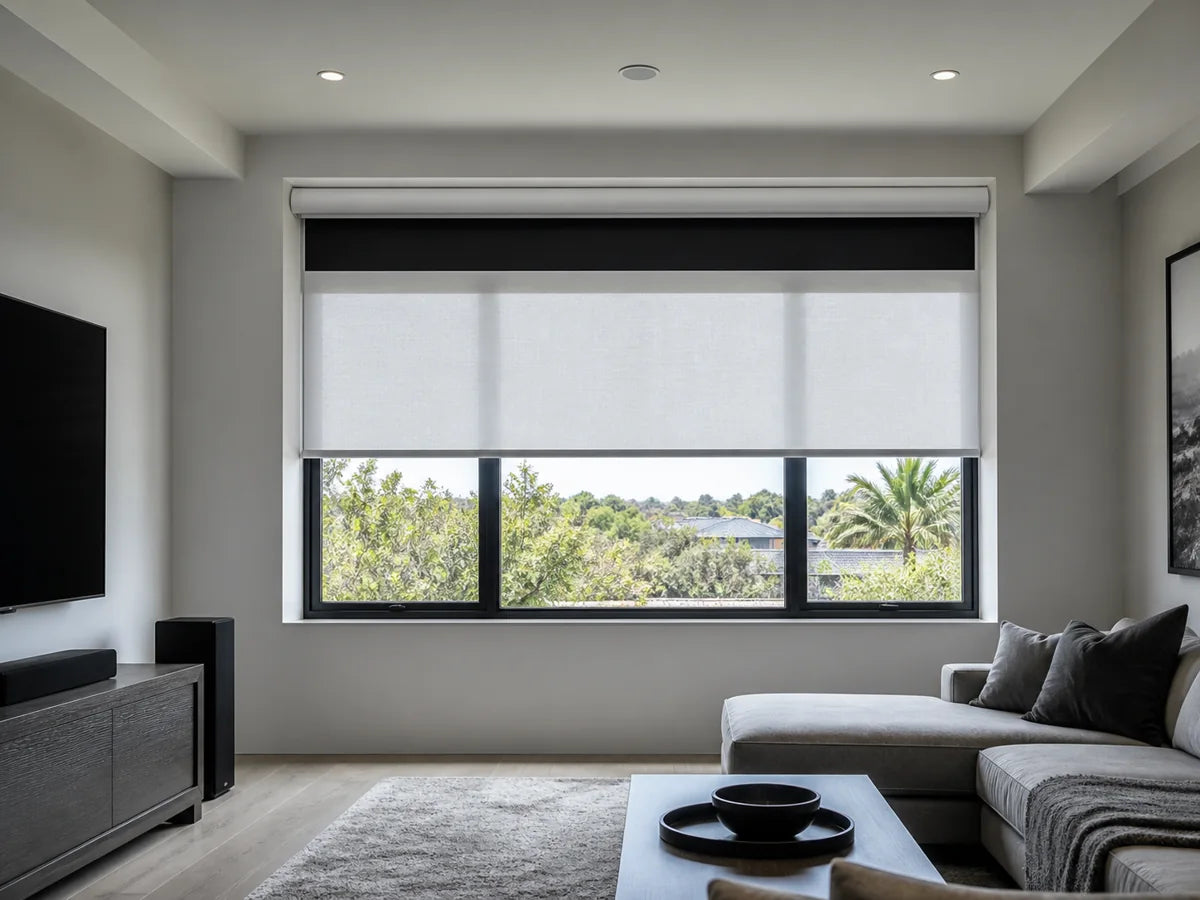
Two shades solve two different moments
A single light-filtering roller can soften daylight but may reveal silhouettes after dark. A single blackout roller can provide stronger coverage but removes most daylight when lowered. A dual system separates those jobs. The daytime layer can remain down during glare hours while the blackout layer stays raised. At night, the opaque layer can lower behind or in front of it.
This is most useful in bedrooms, media rooms, street-facing living spaces and home offices that need different performance throughout the day. It is less useful where one simple privacy level already works.
Choose the two fabrics as a pair
Light filtering + blackout
Diffuse daylight during the day, then add opaque coverage at night. This pairing emphasizes brightness and privacy.
Solar + blackout
Preserve more outward view through an open weave while reducing glare, then lower the opaque layer when privacy matters.
Decorative + room darkening
Use a textured front fabric for appearance and a denser rear layer for stronger coverage. Confirm how both layers look together.
Matching neutral layers
Keep hardware and fabric quiet so the system reads as one architectural treatment rather than two competing shades.
View both samples against the same glass. A daytime fabric that looks warm by itself can change color when the darker rear fabric is lowered behind it.
Front roll or rear roll is a design decision
The layer closest to the glass usually handles daytime solar exposure, while the room-facing layer is more visible when both shades are raised or lowered. Product geometry may limit which fabric can occupy each position. Confirm this before choosing the decorative face.
Also confirm roll direction. A reverse roll can clear a handle or change how the fabric drops, but it may increase the visible gap from the glass. The two layers must move without touching each other, the sill or window hardware.
Dual hardware needs more depth
Two tubes, two fabrics and two bottom rails occupy more space than one roller. A shallow recess may leave the cassette projecting beyond the trim. An outside mount can solve depth limitations, but it changes wall coverage and overall scale.
Blackout fabric still does not erase edge light

A dual system adds a blackout material, not automatically a sealed room-darkening enclosure. Inside-mounted layers still need bracket clearance and can show light at the sides. The front daytime layer does not normally close those gaps.
If darkness is critical, discuss outside-mount overlap, drapery or a purpose-built edge-control system. The blackout roller guide explains the three main light-leak paths.
Independent motors require clear controls
On a motorized dual roller, each layer needs a distinct control identity. “Living room shade” is not enough when the room has a daytime shade and a blackout shade. Use names that describe both location and layer, such as “Office Solar” and “Office Blackout.”
A remote should make the two channels obvious. In an app or voice platform, create simple groups only after each motor operates correctly on its own. A scene can lower the daytime layer during glare hours and switch to the blackout layer at night.
One motor or two?
A true independently motorized dual system normally uses separate drives so either layer can move without the other. Some configurations may mix manual and motorized operation. Confirm what the quoted system includes rather than assuming that “dual” means two motors.
Two motors also mean two power connections or battery-management points. Ask how each battery is charged, whether charging access is reachable and whether both motors report status in the selected app. For larger projects, compare battery and hardwired power before production.
Heat and glare control depend on the daytime fabric
The daytime layer should be selected for the actual orientation and view goal. A more open solar weave can preserve exterior view but usually provides less privacy. A denser light-filtering material can diffuse brightness but may remove the view. Color and openness also influence glare perception.
Closing the blackout layer during peak sun may reduce direct exposure inside the room, but it also removes daylight and view. If heat is the main problem, choose the daytime fabric deliberately rather than expecting the blackout layer to do every job.
Wide windows may need multiple systems
A single dual cassette becomes heavy and visually substantial as width increases. Product limits depend on tube size, fabric, motor torque and mounting conditions. Dividing a wide opening can make service easier and allow independent zones.
Multiple units introduce fabric gaps and more visible seams. On sliding doors, align divisions with door panels when practical. Decide whether access, symmetry or maximum continuous coverage is the priority.
Maintenance doubles if the plan is careless
Two layers mean more fabric surfaces, more moving parts and two bottom rails. Leave enough clearance to dust the sill and inspect the window. Avoid placing décor where either rail can land.
If a motor stops, identify the affected layer before resetting anything. Do not repeatedly operate the second shade if the fabrics are touching or one rail is obstructed. Keep motor names, remote channels and charging instructions with the order record.
Dual roller approval checklist
- State the job of each layer: daylight, view, glare, privacy or darkness.
- View both physical fabrics alone and layered together.
- Confirm which fabric sits closest to the glass.
- Approve cassette height, depth, projection and finish.
- Check handles, cranks, trim and sill clearance for both rails.
- Confirm whether each layer is manual or motorized.
- Document power access, charging method and motor limits.
- Name the layers clearly on remotes, apps and voice platforms.
Questions homeowners ask
Is a dual roller the same as a zebra shade?
No. A dual roller uses two independent shades. A zebra shade uses one continuous loop with alternating solid and sheer bands.
Can both dual roller layers be lowered together?
Often yes, if the product is designed with enough clearance. Confirm the intended sequence and whether the fabrics touch.
Does a dual roller make the room completely dark?
The blackout fabric blocks light through its face, but standard systems can still have edge gaps. Mounting and overlap determine the installed result.
Can I motorize only one layer?
Some configurations may allow mixed operation. Availability depends on the exact hardware, size and manufacturer.
Are dual rollers good for sliding doors?
They can work when cassette depth, walking clearance and shade divisions are planned around the moving door panels.
Blinds100 serves South Bay homes within roughly 15 driving miles of Harbor City. Availability is address-dependent near the edge of the service area.
Review the roller fabric catalogues, see whole-home motorized planning or book a free measurement.