

Cellular shades use folded fabric pockets to create a layer of still air at the window. That construction can improve comfort, soften daylight and stack into a compact shape. The result still depends on fit, fabric, cell depth and how the window is used.
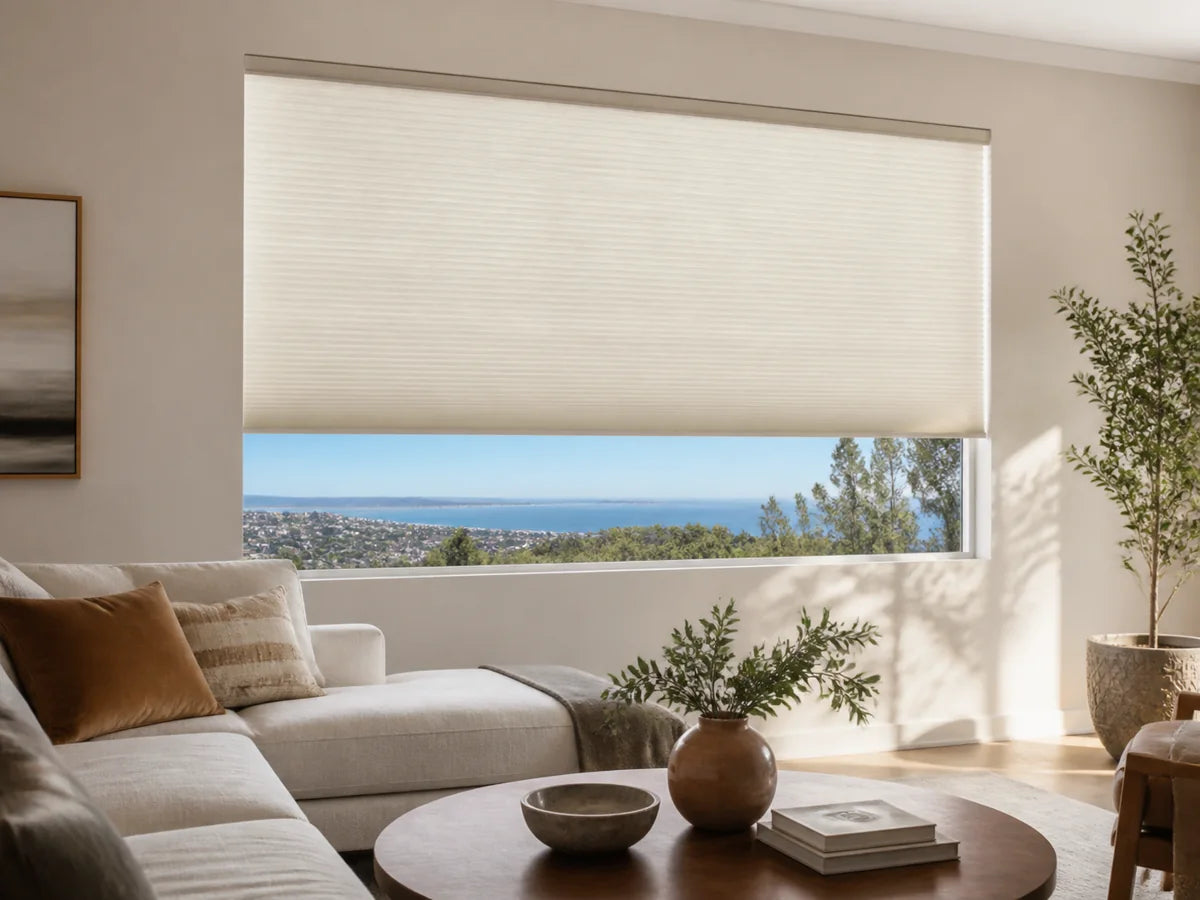
Why the cells matter
A flat shade separates the room from the glass with fabric. A cellular shade adds pockets that resist air movement through the shade itself. That does not change the window glass, frame or wall, but it can reduce the uncomfortable temperature difference a person feels near a hot or cold window.
The benefit is strongest when the shade is down and fitted close to the opening. Large gaps let room air circulate behind it. Raising the shade restores the view and ventilation, but it also removes most of the insulating layer.
Single cell, double cell and cell size
Single cell
One row of pockets usually creates a lighter stack and a straightforward profile. It may be preferred where opening depth is limited.
Double cell
Two rows add another set of air pockets. They can increase thickness and stack size, so confirm the actual sample and hardware.
Small cells
Smaller pleats can suit compact windows. On a tall opening, too-small cells may look busy when viewed across the room.
Large cells
Larger pleats have a more architectural scale. They also change projection, stack height and the way the fabric holds its shape.
Manufacturers do not all build or name cells the same way. Compare the exact cross-section and finished sample rather than treating “double cell” as a universal performance number.
Light filtering and blackout are separate choices
Cell construction and fabric opacity solve different problems. A light-filtering cellular fabric can diffuse daylight while the cells add an insulating layer. A blackout cellular fabric includes a more opaque internal construction, often creating stronger darkness through the face of the shade.
Blackout fabric does not remove the perimeter gaps around a standard installation. Bedrooms that need stronger darkness may require more overlap, an outside mount or a separate edge-control strategy. See the bedroom light-gap guide before assuming fabric opacity guarantees a dark room.
Cellular shades can improve comfort without pretending to replace windows

For sunny South Bay windows, closing a shade before the room overheats is more effective than waiting until late afternoon. A schedule or routine can make that timing consistent. The street-facing surface, fabric opacity and distance from the glass may also affect the result.
Keep expectations honest: a cellular shade is a removable interior attachment. It can help manage heat flow and direct sun, but it does not repair failed seals, stop air leakage around a frame or replace high-performance glazing.
Fit and side gaps influence the result
An inside mount preserves trim and keeps the shade within the opening. Check that the recess is deep enough for the headrail and that the opening is reasonably square. An outside mount can overlap the opening and reduce visible edge gaps, but it covers more wall or trim.
Stack height matters on doors and view windows
When raised, cellular fabric compresses beneath the headrail. The stack is usually compact, but it is not invisible. On a short window, a deeper fabric stack can cover more glass than expected. On a door, confirm that the raised bottom rail clears the handle and the walking path.
For a wide opening, one large shade may create more lift weight and a larger rail. Multiple shades can improve control and serviceability, but they introduce center gaps. Decide whether the priority is uninterrupted coverage, independent operation or a clear doorway.
Top-down bottom-up adds useful privacy
A top-down bottom-up configuration can lower the upper rail while keeping the bottom portion covered. This is valuable in close-neighbor rooms where sky light is welcome but sightlines near eye level are not. The available configuration depends on the product, size and operating system.
Motorization for top-down bottom-up shades is more specialized than a simple up-and-down motor. Confirm exactly which rail moves, how the controls are labeled and whether favorite positions can be saved.
Motorization should match the shade’s weight and use
Motorized cellular shades are convenient for tall windows, grouped rooms and repeatable heat-control schedules. Battery power may suit finished rooms where wiring is unavailable. Hardwired power may be easier to maintain across many frequently used shades when planned during construction.
Ask how the battery is accessed when the shade is fully installed. Also confirm maximum supported width, fabric weight and lift limits. A motor offered for one cellular size may not be available for every large opening. Read battery versus hardwired shade planning before selecting power.
Condensation still needs attention
A close-fitting insulating shade can make the room-facing glass surface behave differently because less room heat reaches it. In a damp room or during cool weather, inspect the window for condensation. Moisture on glass, seals or fabric should not be ignored.
Use ventilation where needed and follow the window and shade manufacturers’ care guidance. A shade should not conceal an existing leak, damaged seal or persistent moisture problem.
What to approve before ordering
- Primary goal: comfort, daylight diffusion, privacy, darkness or a combination.
- Cell construction: compare actual single-cell or multi-cell samples.
- Opacity: light filtering or blackout, tested against the window.
- Mount: inside depth, outside overlap and expected edge gaps.
- Stack: raised height and remaining clear glass.
- Configuration: standard lift or available top-down bottom-up option.
- Power: manual, battery motor or wired motor within published limits.
- Controls: remote, wall control, app or compatible smart-home connection.
Questions homeowners ask
Are cellular and honeycomb shades the same?
Yes. Both names describe the folded pockets that look like a honeycomb when viewed from the side.
Do cellular shades reduce heat?
They can improve window-area comfort and reduce heat transfer when closed. Actual performance depends on construction, fit, glass, orientation and operating schedule.
Are all cellular shades blackout?
No. Cellular shades are available in light-filtering and more opaque constructions. Edge light remains a separate installation issue.
Can cellular shades cover very wide windows?
Some can, within product-specific width and lift limits. Multiple shades may be more practical on very wide openings.
Can cellular shades use voice control?
Some motor systems can connect through a compatible bridge or smart-home platform. Confirm support for the exact motor and control system.
Blinds100 serves South Bay homes within roughly 15 driving miles of Harbor City. Availability is address-dependent near the edge of the service area.
Browse the cellular fabric catalogue, compare cellular and roller shades or book a free measurement.