

Zebra shades create their changing look with two layers of striped fabric. The layers move past one another so the solid bands can overlap for more coverage or separate to reveal the sheer bands. That motion is useful, but it is not the same as tilting a blind slat.
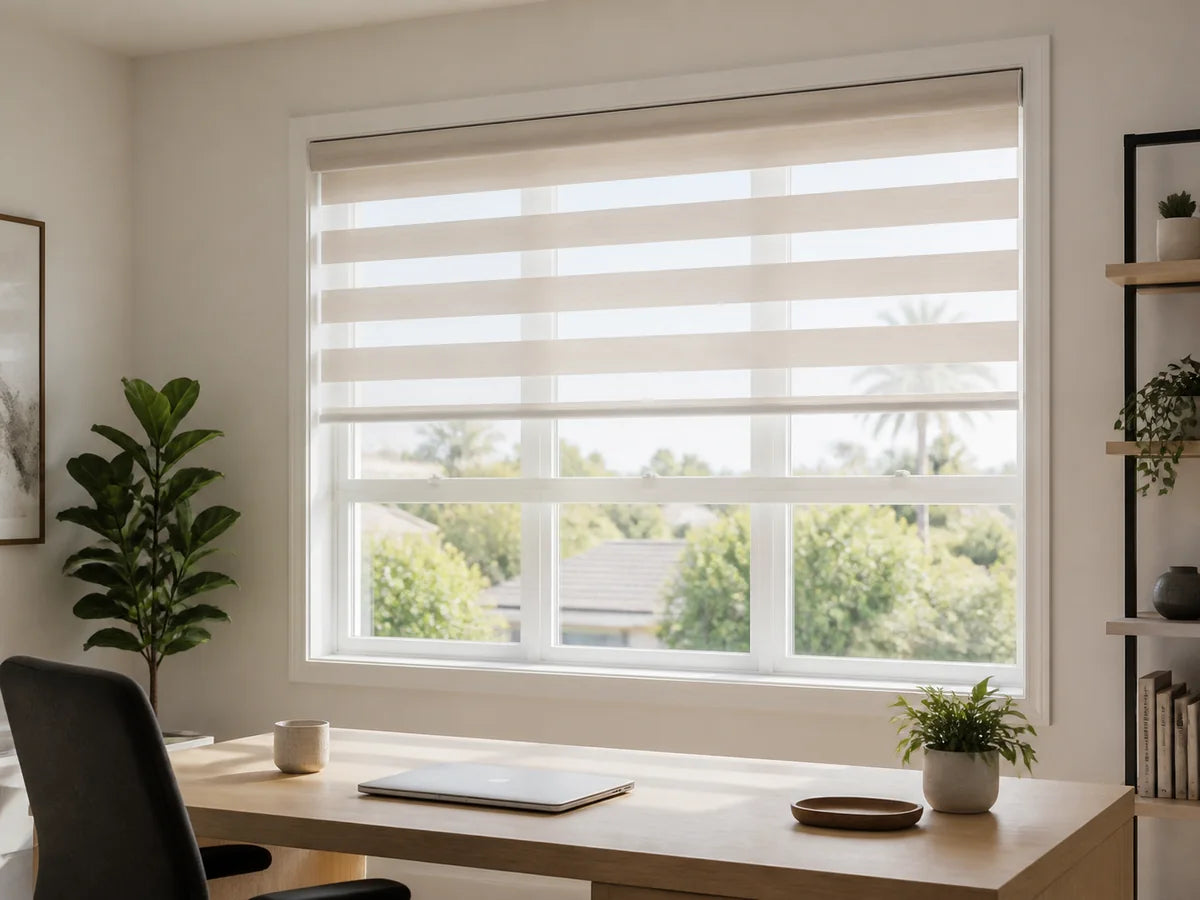
How the bands actually control the window
A zebra shade is built from a continuous loop of fabric. One layer sits in front of the other. When the motor moves the loop a short distance, the bands change alignment. Solid over solid gives more coverage. Solid over sheer opens narrow horizontal view zones. Continuing the movement raises the full shade.
This means the useful positions are related. A small motor movement can change both the amount of view and the height of the bottom rail. The shade does not preserve every band alignment at every height. During selection, operate a full display rather than judging the product from a still photograph.
“Closed” improves privacy, but it is not blackout
When the opaque bands overlap, the face of the shade becomes more private than the open-band position. The sheer layer remains part of the product, however, and light can still enter through the system or around its edges. Most zebra fabrics should be treated as light control rather than true blackout.
If a bedroom needs strong darkness, compare a blackout roller system or a layered treatment. Zebra shades are usually strongest in living rooms, offices and shared spaces where adjustable daylight matters more than darkness.
Band scale changes the room
Wide stripes create a stronger architectural pattern. Narrower stripes can feel quieter, especially on smaller windows. The scale also changes how much clear view appears when the sheer portions align. Review a sample from the distance where you will normally see the window, not only from arm’s length.
On adjacent windows, band alignment deserves an explicit conversation. Separate shades may begin at slightly different positions because window sizes and installed heights vary. If continuous horizontal alignment is important, say so before measurement. Exact visual continuity may be limited by product construction and window conditions.
Fabric choice affects more than color
Sheer visibility
Some sheer bands feel open and transparent. Others diffuse the view. Look through the sample toward a real exterior scene.
Solid-band opacity
A pale band may glow strongly while a dense dark band appears more graphic. Confirm the actual weave rather than assuming from color.
Street-facing appearance
The reverse side may not look identical to the room-facing side. Check exterior-facing color where community rules or curb appearance matter.
Pattern repeat
The relationship between stripe height and window height affects where the bands land at common stop positions.
Motorization makes the useful positions repeatable
A motor can return the shade to programmed upper, lower and favorite positions. That is valuable with zebra fabric because the privacy effect depends on band alignment. A favorite position can place the shade at a comfortable height with the sheer sections aligned for daylight.
Ask how the limits are set and whether a preferred band position can be recalled consistently. Also ask what happens after charging, a power interruption or a reset. Control options may include a remote, wall control, app, schedule or compatible smart-home platform. Compatibility belongs to the exact motor and bridge, not to the fabric style in general.

Plan controls around the people using the room
Voice control is convenient when hands are full or a window is hard to reach. It should not be the only obvious control. Keep a labeled remote or wall control available for guests, older family members and anyone who does not use the home’s app.
For schedules, start with a simple routine: open-band position after sunrise, more closed during high-glare hours and raised when the view matters most. Complicated automations are harder to troubleshoot and often get abandoned. See the whole-home motorized shade planning guide for room grouping and control naming.
Check the cassette and bottom rail in person
Zebra systems carry two fabric layers, so the headrail or cassette has more visual presence than a minimal open roller. On a shallow inside mount, part of the cassette may project beyond the trim. Confirm available depth, bracket location and whether the chosen cassette can sit fully recessed.
The bottom rail travels with the fabric loop and helps maintain the layered geometry. Check its size and finish against the window frame. On doors or frequently opened windows, confirm that the moving rail will not strike a handle.
Cleaning and daily use
Dust is easier to notice on some alternating weaves than on a flat roller. Use the manufacturer-approved method for the selected fabric. Gentle dusting or low-suction vacuuming may be appropriate, while aggressive rubbing can distort a sheer section. Test any spot-cleaning method in an inconspicuous area.
Do not pull the layered fabric apart or place objects between the layers. If the fabric tracks unevenly, stop operation and inspect for an obstruction rather than forcing the motor.
Approval checklist for motorized zebra shades
- Operate a full-size display through open bands, closed bands and fully raised positions.
- Test daytime and nighttime privacy with the actual fabric sample.
- Confirm cassette depth, projection, finish and mounting position.
- Discuss band alignment across adjacent windows before ordering.
- Check handles, locks and trim for moving-hardware clearance.
- Choose power: rechargeable battery, replaceable battery or wired where available.
- Confirm remote, wall control, app and smart-home compatibility by exact model.
- Save a practical favorite position rather than relying on tiny manual adjustments.
Questions homeowners ask
Are zebra shades the same as dual roller shades?
No. Zebra fabric is one continuous loop with alternating bands. A dual roller uses two separate shades, often one light filtering and one blackout.
Can zebra shades block a TV reflection?
Closing the bands can reduce bright view and contrast, but performance depends on fabric, orientation and screen position. Test the problem time of day.
Do zebra shades provide privacy at night?
The closed-band position improves coverage, but evaluate the real material from outside with interior lights on. Edge gaps and sheer construction still matter.
Can the bands line up across several windows?
They may be coordinated, but exact alignment can be affected by different window sizes, mounting heights and fabric construction. Make alignment a written priority before production.
Can motorized zebra shades use voice control?
Some systems can when paired with a compatible bridge or platform. Confirm support for the exact motor before purchase.
Blinds100 serves South Bay homes within roughly 15 driving miles of Harbor City. Availability is address-dependent near the edge of the service area.
Browse the zebra fabric catalogue, compare roller shades with zebra shades or book a free measurement.