

Fabric vertical blinds use individual soft vanes that hang from a headrail, rotate for light control and traverse sideways for access. They fit the horizontal movement of a sliding door without pretending to be a roller shade, panel track or rigid PVC vertical.

Why vertical movement suits a sliding door
A patio door moves sideways, so a treatment that also moves sideways can clear the active panel without lifting a large shade overhead. The vanes can rotate while covering the glass, then traverse toward one side or split from the center when full access is needed.
The best draw direction follows the door, furniture and traffic pattern. A beautiful stack placed in front of the frequently used handle becomes frustrating every day. Decide the stack before choosing fabric.
Choose the draw before the color
Left stack
Works when the left side can hold the full bundle and the active door panel remains clear.
Right stack
Mirrors the same logic for a door that opens or is approached from the opposite side.
Center split
Creates a balanced appearance and divides the stack, but leaves fabric at both outer sides.
One-way draw
Keeps operation simple and concentrates service access on one end of the headrail.
Mark the proposed stack width with painter’s tape. Open the door, move through it and check the view from the main seating area. This reveals whether the stack interferes with the handle, walkway or desired glass exposure.
Fabric vanes are not cheap plastic slats
Rigid PVC verticals are familiar because they were widely used on apartment doors. Fabric vanes create a softer surface, a quieter visual rhythm and more textile choice. They still retain the practical vertical-blind behavior of rotation and side draw.
Fabric is not damage-proof. A pet, moving chair or strong breeze through an open door can displace vanes. Review how the chosen material hangs, whether it uses bottom weights or connectors and how individual vanes can be serviced.
Rotation gives graduated light control
With the vanes turned open, the room receives narrow view corridors and directional daylight. Rotating them toward closed increases overlap and privacy. Because each vane is separate, the result has repeated vertical lines rather than one uninterrupted fabric plane.
The closing direction matters. From one angle, partially closed vanes may protect the room from a neighbor’s sightline while preserving light from another direction. Test the display from inside and outside rather than assuming one “closed” position handles every view.
Nighttime privacy depends on overlap and lighting
Closed fabric vanes can provide strong visual coverage when they overlap correctly. Gaps can appear if a vane is twisted, the track is not level or air movement shifts the fabric. Bright interior lighting also makes any opening more noticeable from outside.
Headrail position controls clearance
An inside mount can look integrated when the recess has enough depth and the door handle does not project into the vane path. An outside mount can place the headrail above the opening and create more overlap, but it requires suitable wall support.
Measure the full projection of handles, locks and screens. Fabric vanes should rotate without striking them. Confirm floor clearance at several points because patios and interior flooring are not always level.
Stack width is part of the view
When the treatment is open, the vanes gather into a visible bundle. More vanes and heavier fabrics create a larger stack. If maximum clear glass is important, the track may need to extend beyond the opening so part of the stack rests over the wall.
That extension needs wall space and changes visual symmetry. On a tight corner, a smaller clear opening may be the unavoidable tradeoff. Ask for an estimated stack width based on the actual ordered size.
Compare fabric verticals with drapery sheers honestly
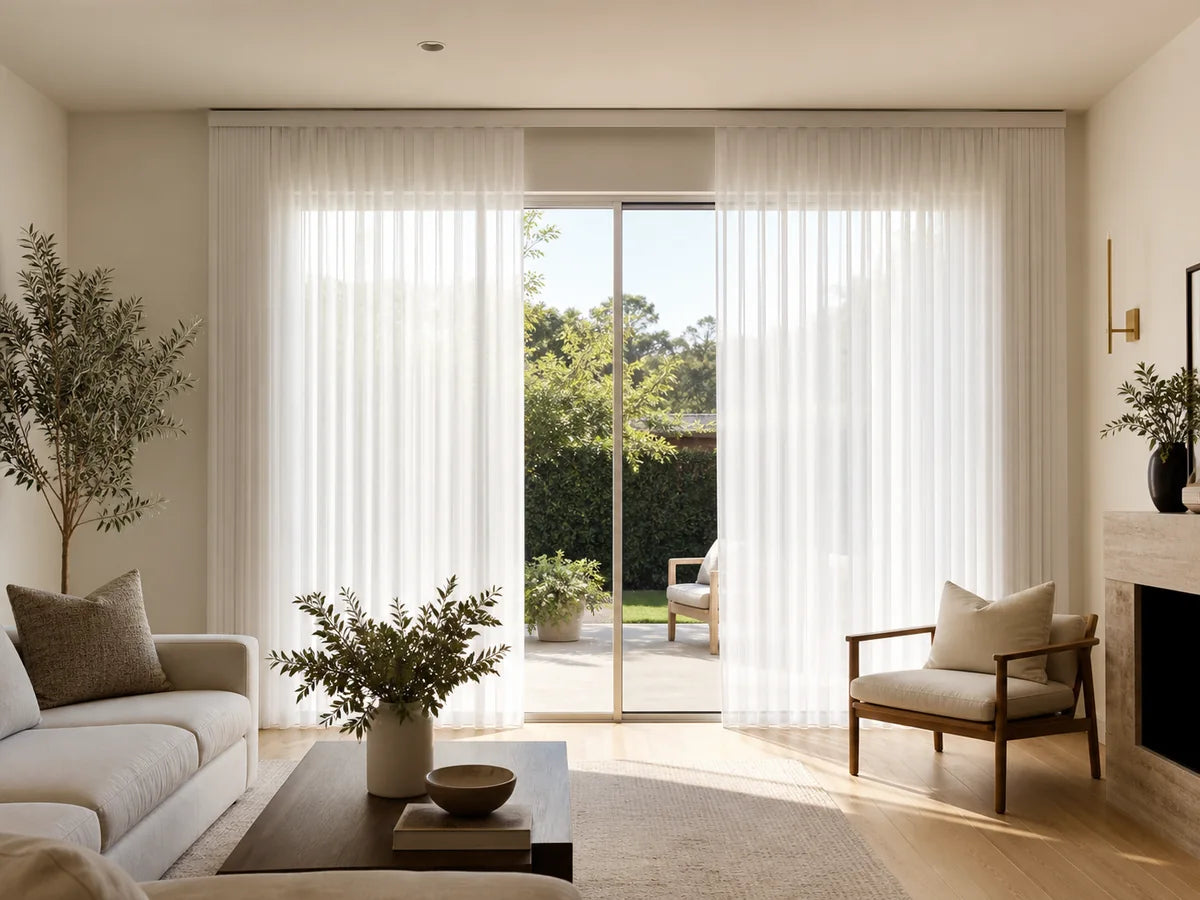
Drapery sheers emphasize flowing folds and a residential textile look. Fabric verticals emphasize rotation, replaceable individual elements and practical side draw. A panel-track shade uses broad flat panels instead of narrow vanes. These products should not be presented as interchangeable.
Choose based on the desired movement and appearance. If precise vane rotation is useful, fabric verticals have an advantage. If layered softness is the main goal, drapery may fit better. If a wide contemporary plane is preferred, a panel system may be worth comparing.
Heat and glare control vary by fabric and angle
Rotating vanes can redirect direct sun while retaining some daylight. A denser fabric can reduce glare more strongly than a sheer one, but it also changes the view and room brightness. The gaps between open vanes mean performance changes quickly with angle.
For a west-facing door, test the material when low afternoon sun reaches the glass. A sample viewed under showroom lighting cannot reproduce that condition. Use the South Bay heat-control guide to separate comfort goals from darkness goals.
Operation and child safety
Control options depend on the selected track. Where children live or visit, choose cordless or inaccessible-cord operation that follows current safety requirements. Do not leave a looped cord or chain accessible behind furniture.
Motorized traverse or rotation may be available on some systems, but confirm the exact capability, size limit and emergency access. Do not assume a motor controls both drawing and rotation unless the product documentation says so.
Cleaning and service
Individual fabric vanes can often be dusted with a soft tool or low-suction vacuum, subject to manufacturer guidance. Avoid saturating weighted hems or scrubbing a sheer weave. Test any spot cleaning away from eye level.
One benefit of separate vanes is that a damaged piece may be serviceable without replacing the entire treatment. Dye lots and sun exposure can make a later replacement look different, so keep the fabric name, color code and order record.
Approval checklist for sliding doors
- Identify the active door panel and everyday walking direction.
- Choose left, right or center-split draw before approving fabric.
- Estimate the full stack width and remaining clear glass.
- Check handle, lock, screen and floor clearance.
- Test rotation for daylight, glare and sightline control.
- Review nighttime privacy with interior lights on.
- Confirm headrail finish, mounting support and service access.
- Document cordless, wand or available motorized operation.
Questions homeowners ask
Are these the same plastic vertical blinds used in rentals?
No. This guide describes individual fabric vanes. They use vertical-blind movement but create a softer textile appearance than rigid PVC slats.
Can fabric verticals open from the center?
Many systems offer a center split, subject to track configuration. Confirm the stack space required on both sides.
Will fabric vanes blow around when the door is open?
Moving air can displace them. Close the treatment or secure the door condition according to product guidance during strong airflow.
Can one damaged vane be replaced?
Often it can, but matching later may be affected by dye lot and sun exposure. Keep the original order information.
Do fabric verticals provide blackout?
They can provide substantial coverage with an opaque fabric, but overlap gaps, track edges and floor clearance prevent a universal blackout promise.
Blinds100 serves South Bay homes within roughly 15 driving miles of Harbor City. Availability is address-dependent near the edge of the service area.
See the sliding-door comparison guide, browse the available catalogues or book a free measurement.