

Roller shades and zebra shades can use similar headrail space and motor controls, but the fabric moves differently. A roller presents one continuous sheet. A zebra uses two striped layers that shift between solid and sheer alignment. Choose the movement you want to live with, not only the photograph you like.
The short comparison
| Decision | Roller shade | Zebra shade |
|---|---|---|
| Visual style | Quiet continuous surface | Strong horizontal pattern |
| Daylight adjustment | Change shade height or fabric opacity | Shift band alignment, then change height |
| Blackout option | Available with opaque fabric, subject to edge gaps | Usually not a true blackout system |
| View control | Solar weave can preserve broad view | View appears through repeated sheer bands |
| Cleaning | One flat fabric surface | Two layered surfaces and sheer bands |
| Motor behavior | Simple height positions | Height and band alignment are related |
Roller shades are visually quieter
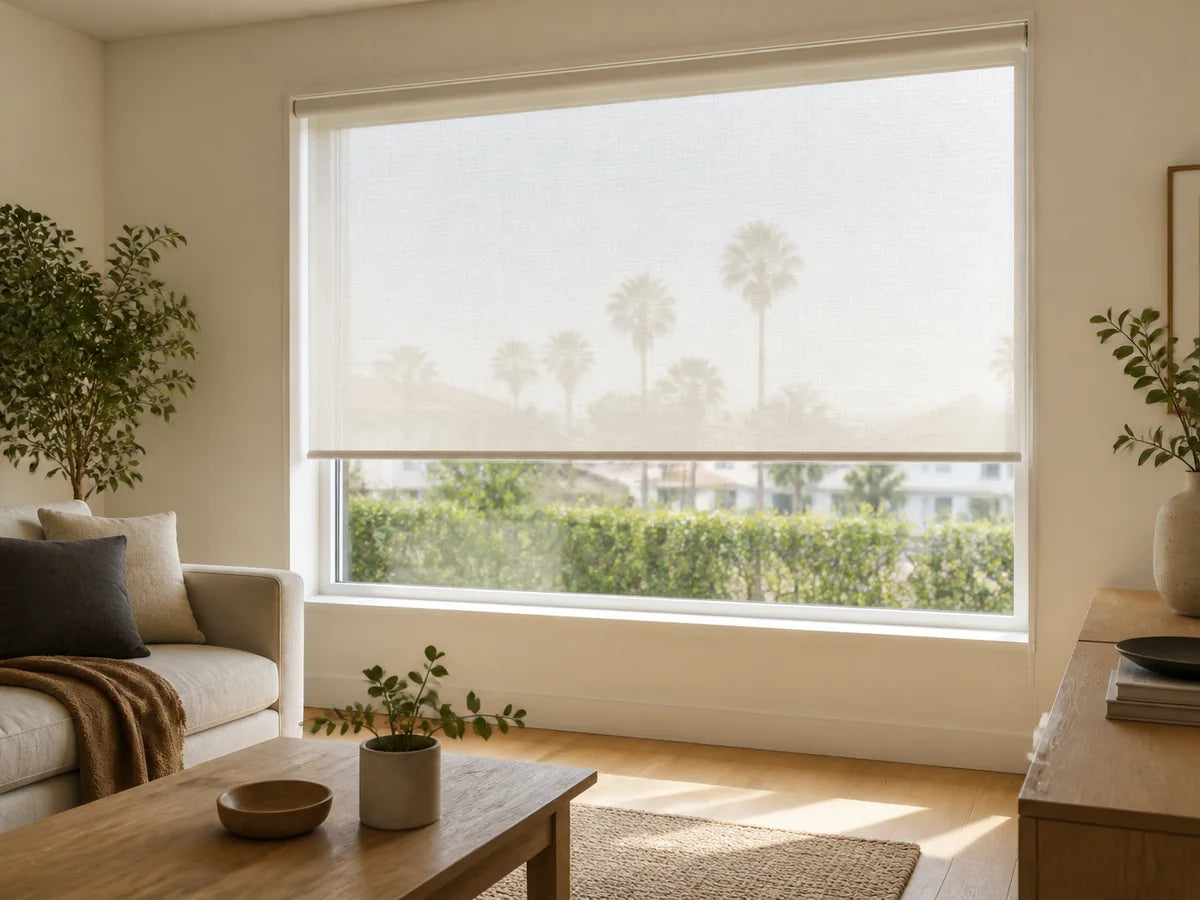
A roller shade reads as one plane when lowered. In a pale neutral fabric, it can recede into the room. In a textured weave or strong color, it can act as a large design surface. There are no repeating horizontal sheer bands.
This simplicity works well when architecture, art or exterior view should remain the visual focus. It also makes the raised and lowered states easy to understand: more glass or more fabric.
Zebra shades make light control visible
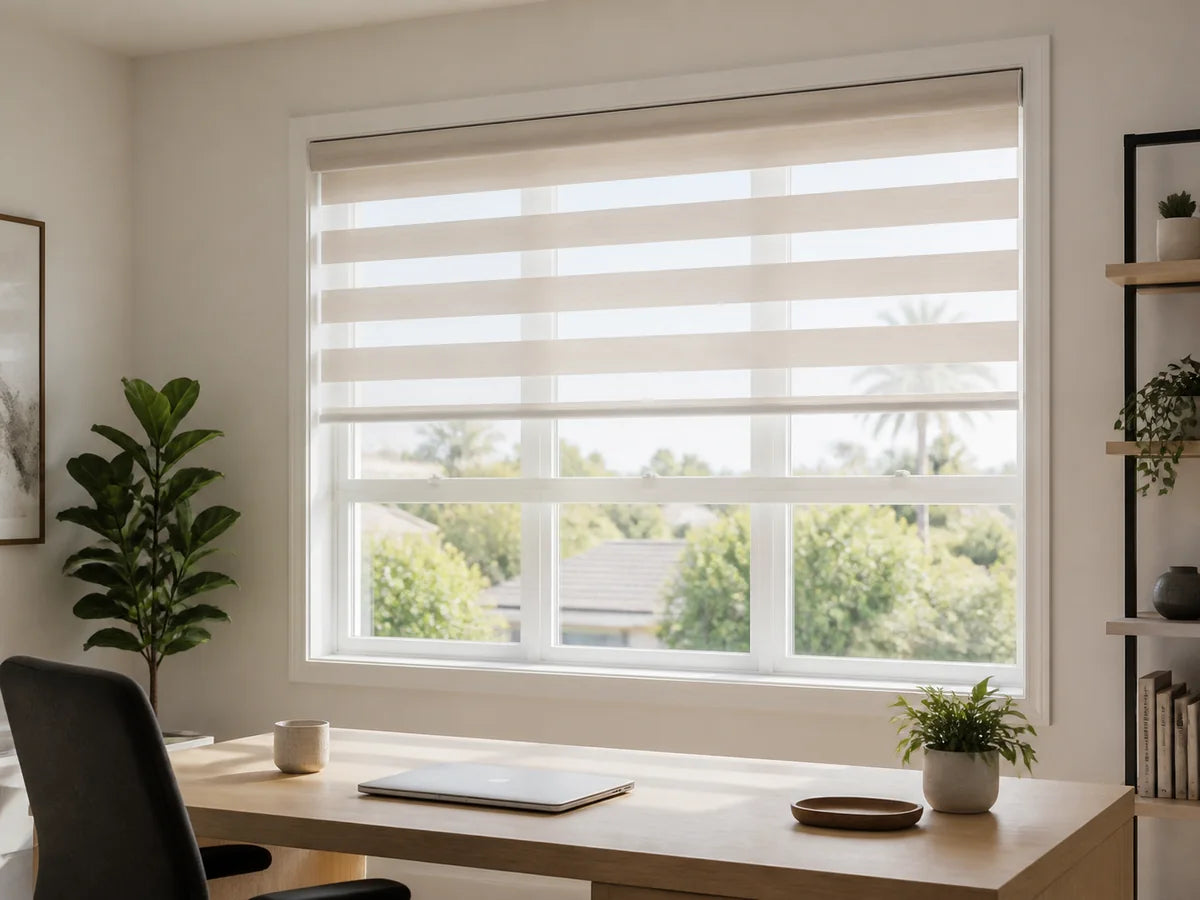
Zebra bands create an active pattern even when the shade stays at one overall height. A small movement changes how much sheer area is exposed. This can feel more adjustable than a plain roller, especially in an office or living room where partial view matters.
The tradeoff is visual activity. A wide wall of zebra shades produces many horizontal lines. View a full-size sample from across the room before committing to a band scale.
Privacy is not decided by the product name
A light-filtering roller can obscure detail during the day, but bright interior lighting can reveal silhouettes after dark. A solar roller preserves more view and usually less privacy. A blackout roller blocks view through the fabric, while edge gaps remain.
A zebra shade improves privacy when the solid bands overlap, but the sheer layer and perimeter still matter. Neither style should receive a universal nighttime-privacy promise without a real sample test. See the nighttime privacy guide.
For darkness, roller shades have the clearer path
Roller systems can use opaque blackout fabric and can be combined with outside-mount overlap, drapery or specialized edge control. Zebra fabric is designed around alternating sheer and solid sections, so adjustable light is its defining feature.
A bedroom can still use zebra shades if darkness is not critical. For a nursery, media room or night-shift sleeper, evaluate a blackout roller or dual roller before choosing zebra based on appearance alone.
For a preserved view, compare solar rollers with open-band zebra
A solar roller creates view through a continuous open weave. The view is softened by the mesh but not divided into stripes. Zebra shades create clear horizontal view zones between solid bands. People experience those two views differently.
Stand at the main seating position with both samples. Look toward the brightest outdoor scene. A tiny handheld sample viewed against an interior wall cannot show the actual contrast.
Glare control depends on more than openness
TV and monitor glare comes from the relationship between the window, sun angle, room brightness and screen. A denser roller can reduce the bright source across the whole pane. A zebra shade in open-band position still admits repeated bright strips.
Closing zebra bands may improve glare control, but it also changes view and privacy. Test during the problem hour. The screen-glare planning guide explains why direct reflection and room contrast are separate problems.
Hardware size is product-specific
A basic roller may use an open roll, cassette or fascia. Zebra systems need room for a continuous double layer and usually present a more substantial headrail. Exact projection depends on shade size, tube and cassette.
Do not compare two products using fabric samples alone. Approve the headrail profile, end caps, bottom rail and inside-mount depth for the actual ordered size.
Motorization feels different on each style
Motorized rollers use upper, lower and favorite height positions. The state is straightforward. Motorized zebra shades also benefit from a saved band-alignment position because a small movement changes the sheer-to-solid relationship.
For voice control, use names that describe the room rather than the fabric. Keep a remote or wall control available. Platform compatibility depends on the exact motor, bridge and ecosystem for either style.
Cleaning favors the simpler surface
A roller exposes one main fabric surface. Zebra shades have two layers and alternating sheer sections that can show dust differently. Both need the cleaning method approved for the selected textile.
Homes with frequent patio-door airflow, cooking residue or pets should consider access for cleaning. Do not choose a delicate sheer band where it will be regularly touched or brushed by furniture.
Which rooms usually favor each option?
Roller often fits
Minimal living rooms, blackout bedrooms, solar-control offices, large window walls and rooms where the shade should disappear visually.
Zebra often fits
Home offices, dining rooms and living spaces where visible band adjustment is part of the design.
These are starting points, not rules. A well-chosen fabric and correct installation matter more than a generic room label.
Use this five-minute showroom test
- Operate both shades from fully raised to fully lowered.
- Stop the zebra at three different band alignments.
- Look through both products toward a bright exterior view.
- Stand to the side and inspect headrail projection.
- Close each for privacy, then evaluate the reverse side.
- Ask how the favorite motor position is saved and recalled.
Questions homeowners ask
Which costs more?
Price depends on fabric, size, hardware and motorization. Zebra construction can add complexity, but compare complete specifications rather than style names.
Which is more modern?
Both can be modern. Rollers create a quiet plane. Zebra shades create a more graphic layered pattern.
Which is better for bedrooms?
A blackout roller usually provides a clearer path to room darkening. Zebra can work when adjustable daylight is more important than strong darkness.
Which is better for an office?
Either can work. Choose based on the screen position, exterior view and whether striped or continuous glare control feels better.
Can both be motorized?
Yes within product-specific size and weight limits. Zebra shades need careful favorite-position setup for useful band alignment.
Blinds100 serves South Bay homes within roughly 15 driving miles of Harbor City. Availability is address-dependent near the edge of the service area.
Read the full motorized roller guide, review the motorized zebra guide or book a free measurement.